
Author: Daniel Crespo
Role: Analytics and Workforce Management Professional
Date: August 1, 2021
Introduction
In this article, I share the challenges I faced using Solver to create schedules for 24/7 set-ups, the solutions I came up with, and the outcomes. Moving from a 5-day service window to a 24/7 operation introduces several new constraints that must be handled carefully in any Workforce Management model.
Key challenges when moving to 24/7 scheduling
When jumping from a 5-day service window to a 24/7 set-up, these are the main problems that need to be solved:
1. Schedule inflexibility
Schedule inflexibility is present in any scheduling process, and it’s impossible to eliminate it completely. However, it can be reduced. The main way to do this is by adding as many schedule possibilities as you can to your model. The more options Solver has, the better it can fit coverage to demand.
2. Days off become part of the equation
In a 24/7 environment, days off are no longer a simple “weekend” concept—they become part of the optimization problem and need to be distributed across the entire week. If you don’t give enough options to distribute days off, you’ll end up with unbalanced schedules.
3. Higher demand for one of the weekend days
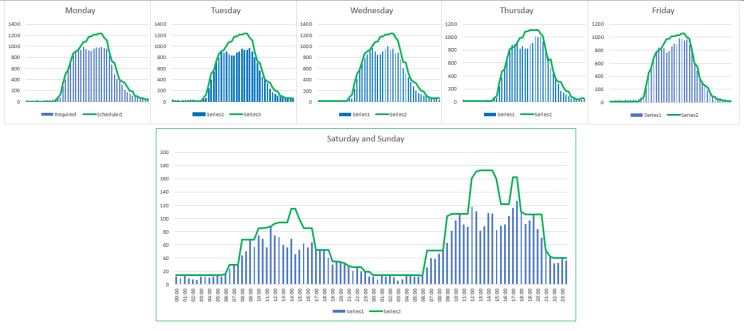
Different demand levels on weekend days caused a lot of struggle at first. I could get good schedules for the weekdays, but weekends were heavily overstaffed. Initially, I thought I could manually replace some schedules and fix the issue quickly — but the goal was to create a model that didn’t require manual work.
The solution was to create a model exclusively for the weekends. By separating weekday and weekend logic, Solver could better handle the different demand patterns and produce more efficient staffing for each.
Crossing‑Midnight Schedules
Crossing-midnight schedules impact two different days. The concept is easy to understand, but it represents a challenge when calculating and graphing Requirement vs. Scheduled. I created many different models to handle this, and while they produced some schedules, nothing was truly perfect.
This is the only thing I couldn’t fully solve with the 24/7 Solver models — at least for now. I’m still working on it and will share an update if I figure out a way to get great cross-midnight schedules at a single click.
That said, I’m somewhat happy with the result because the cross-midnight schedules only take about five minutes to add manually after running the model, especially since the only ones missing are Monday–Friday. Weekends are fully covered.
Conclusions
Based on this experience, here are a couple of key conclusions:
- 24/7 schedules can definitely be done with Solver.
- The resulting schedules aren’t perfect, but they are good enough to work with and refine.
Solver is a powerful tool for Workforce Management, especially when you’re willing to experiment, iterate, and step out of your comfort zone to try new modeling approaches.
Disclaimer
This article expresses my personal opinion on the topic discussed and not that of any company. Nor do I share any data from any company.